
Despite decades of research and treatment options, tuberculosis (TB) remains one of the world’s most devastating infectious diseases, claiming more than one million lives each year and continuing to challenge global public health efforts.1, 2, 3 Drug resistance, immune evasion, and global disparities in healthcare access continue to fuel its persistence.
Each year, World TB Day highlights the ongoing global effort to eliminate tuberculosis and accelerate the development of new diagnostics, treatments, and vaccines. Mycobacterium tuberculosis (Mtb) has plagued humans for probably 70,000 years and remains a global threat to this day.2,4
What makes this ancient pathogen so resilient, and how are researchers working to develop new tools to combat it?
The Global Burden of Tuberculosis
In 1882, Robert Koch recognized Mtb as the causative agent of tuberculosis (TB), but it took decades for the first effective anti-TB antibiotics to be developed in 1944.2 TB remains a leading cause of death from a single infectious agent, with over 10 million new cases and 1.25 million deaths reported globally in 2023.1 Even today, Mtb continues to challenge clinicians and researchers due to its intracellular survival strategies, ability to form granulomas that can harbor latent organisms, and increasing resistance to first- and second-line therapies.3 TB is estimated to have caused more than one billion deaths in the last 200 years.2 The US population is at low risk of TB infection, with approximately 10,000 reported cases in 2024.5 The CDC has a surveillance program to test for and treat these infections to prevent progression to disease5. This approach helps to reduce mortality and community spread from TB.5 Risk factors for TB include HIV infection, undernutrition, diabetes, smoking, and alcohol consumption.1
TB Infection Cycle
Mycobacterium species cause a variety of illnesses, including Hansen’s disease, or leprosy, as it is commonly called, which results from Mycobacterium leprae and mainly affect the skin, nerves and lining of the nose. M. bovis often produces TB symptoms in cattle, though humans may also become infected, commonly through raw milk from infected cattle. Not everyone exposed to these bacteria becomes sick, but infections caused by M. bovis can affect the lungs and lymph nodes in particular.6,7,8
Typically, TB is spread via aerosolized particles; once inhaled, the bacillus can become trapped in the upper airways and then gain access to the lower respiratory tract. The bacteria usually remain in the lungs but in some cases can spread to other organs.3,9
When an individual presents no symptoms, this is called latent TB infection (LTBI). 6,10 In many cases, LTBI may never develop into active TB, but for others, the infection can emerge and cause TB disease.6 The risk of developing active TB is much higher in people with weaker immune systems and/or those with HIV infection.6 For people that develop active TB, symptoms of tuberculosis lung infection they experience will include a severe cough lasting three weeks or more, chest pain, coughing up blood or sputum, fatigue or weakness, weight loss, lack of appetite, chills/fever, and night sweats.9
The infection cycle of TB is shown graphically in Figure 1, illustrating how inhaled M. tuberculosis bacteria infect macrophages in the lungs and may progress to either latent infection or active disease. The M. tuberculosis infection stimulates the formation of these granulomas. Within these granulomas, the bacteria can persist for years and years, and may persist for the lifetime of the host.3,6,10,11 There is some evidence that as the bacteria replicate within macrophages, they cause the death of their host cells, and as new macrophages swarm in to “clean up” those dead cells, they then become infected themselves.10 This process enables the bacteria to quickly expand their numbers. In this way, M. tuberculosis flips the normal function of this host response, using the proximity of macrophages attracted to the infection to their own advantage.10

Figure 1: Tuberculosis infection cycle in humans. Inhaled Mycobacterium tuberculosis bacteria infect lung macrophages and may lead to either latent infection or active tuberculosis disease.
Tuberculosis is transmitted when aerosol droplets containing Mycobacterium tuberculosis are dispersed via coughing and inhaled into the lower lungs of a new host. Macrophages are recruited to the interior lung surface by the bacilli and become infected; in some cases, these infected macrophages can cross the lung epithelia to deeper tissues. Granulomas can form when more macrophages and other immune cells arrive at the infection site; some of these cells are infected and become necrotic. This necrotic center of the granuloma supports bacterial growth and further transmission to a new host.10
The current evidence suggests that the granulomas present during active disease can have a wide range of structures, with bacteria-laden lesions or large open cavities, whereas during a latent TB infection, closed granulomas with central necrotic lesions contain few bacteria.3,6,10
TB Cleverly Evades the Immune System
Like many difficult-to-eradicate bacterial pathogens, TB needs to infect, survive, and replicate within human cells; its ability to do so allows it to evade the host immune system that would typically act to control it. Unlike many bacterial pathogens, Mtb does not rely on virulence factors or toxin production to infect its hosts, but has developed a strategy to evade, modulate, and exploit the host immune system to act in its favor.10,11 A specific lipid on the bacterial surface is key to directing Mtb to host phagocytic cells, namely macrophages or other immune cells.10,11 Invading bacteria are normally phagocytosed and killed by macrophages and neutrophils in the lungs, but Mtb has evolved a strategy of preventing the main mechanism of bacterial eradication, that of fusion of the phagosome with lysosomes.10,11,12 Lysosomes are cellular organelles that are filled with enzymes that have the responsibility of degrading foreign invaders such as bacteria (Figure 2). Within these phagosomes, Mycobacteria can replicate to large numbers until the cell bursts, and the bacteria can go on to infect fresh cells.3,10, 12

Figure 2: Mycobacterium tuberculosis survives inside host immune cells by preventing the normal fusion of phagosomes with lysosomes. In contrast, most bacteria are destroyed when engulfed by immune cells through lysosomal degradation. Concept adapted from Warner and Mizrahi, Nature Medicine (2007).
The biggest challenges for eradicating, treating, or eliminating TB are drug-resistant TB and co-infection with human immunodeficiency virus (HIV).1
How Antibiotic Resistance Makes TB So Dangerous
Drug-resistant M. tuberculosis is a huge challenge for clinicians because treatment for this infection involves regimens of multiple anti-TB agents over a long span of time.13,14 Drug-resistant Mtb is defined as those bacteria that are resistant to at least one first-line anti-TB drug, whereas multidrug-resistant Mtb (MDR-TB) are those organisms that are resistant to more than one anti-TB drug, including at least isoniazid (INH) and rifampin (RIF).14 Clinicians have also come across what are known as pre-XDR-TB; these are resistant to INH, RIF, plus a fluoroquinolone or a second-line injectable drug such as amikacin, capreomycin, or kanamycin. Most troubling are cases of extensively drug-resistant Mtb (XDR-TB) – according to the definition adopted by the CDC in 2021, these are resistant to INH, RIF, plus a fluoroquinolone-class drug as well as at least one of three second-line drugs (such as kanamycin, amikacin, or capreomycin) or INH, RIF, a fluoroquinolone, plus one of the newer approved agents for treating TB, bedaquiline or linezolid.15,16
Drug-resistant Mtb can arise when drugs used to treat this infection are misused, or the full course of therapy is not completed, or the incorrect drugs are given.15 The death rate from TB is approximately 50% if left untreated, but with modern treatment regimens, the cure rate for drug-susceptible TB is now approximately 88% globally (Figure 3).1 Treatment success for multidrug-resistant or rifampicin-resistant TB (MDR/RR-TB) has also improved, reaching approximately 71% globally.1
Despite these improvements, a meaningful gap in treatment outcomes remains between drug-susceptible and drug-resistant disease.

Figure 3: Global tuberculosis treatment success rates. Treatment success for drug-susceptible TB is approximately 88% worldwide, compared with about 71% for multidrug-resistant or rifampicin-resistant TB (MDR/RR-TB), highlighting 17-percentage-point difference in treatment outcomes. Data derived from the WHO Global Tuberculosis Report 2025.
In response to growing drug resistance, the CDC and WHO have released updated treatment guidelines. The CDC now recommends shorter, all-oral regimens for drug-susceptible and multidrug-resistant TB, including the 4-month isoniazid-rifapentine-pyrazinamide-moxifloxacin (HPZM) regimen for drug susceptible TB and the 6-month bedaquiline-pretomanid-linezolid-moxifloxacin (BPaLM) regimen for MDR-TB.14,15 WHO has endorsed similar reduced treatment course regimens for pre-XDR-TB.16 These shorter all-oral regimens were adopted as they were found to be as effective as previous regimens despite their shorter duration, fewer numbers of medications, reduced pill burden, and less adverse drug effects, making them more accessible and acceptable to patients.15
Vaccine development against Mtb is also advancing. A promising mRNA-based TB vaccine has shown efficacy in preclinical trials, especially as a booster to the traditional Bacillus Calmette–Guérin (BCG) vaccine. Additionally, the M72/AS01E candidate has demonstrated a 50% reduction in pulmonary TB cases, and over 17 vaccine candidates are currently in clinical development.1,17,18
Treatment Challenges
Even though anti-TB drugs were discovered in the late 1940s (streptomycin, isoniazid, and para-aminosalicylic),2 morbidity and mortality caused by tuberculosis remains high. Treatment of this infection is complicated by several factors.
- Cell penetration: the intracellular lifestyle of this organism requires that anti-TB drugs penetrate cells and cellular compartments to access the bacteria
- Growth rate: the slow growth of this organism makes finding the source of infection difficult, leading to extended treatment that makes compliance a challenge
- Resistance: when a Mtb isolate is multi-drug resistant, multiple antibiotics that have adverse side effects need to be administered
- Dormancy: the dormant state of this organism makes it difficult to target during latency as many drugs work best against active infections
- Co-infection: in many regions there is a high incidence of Mtb and HIV co-infection, where a lowered host immune response allows TB to flourish 1, 3, 4, 6,11, 13
Similar regimens are recommended for patients with latent TB infection or with HIV,1,15 as these present further challenges for clinicians. Options are more limited for patients who have drug-resistant TB but there is some indication that the recommended regimens have been having some success, as demonstrated by the recent guidelines with shorter treatment regimens and improvements in success rates (Figure 3). 1
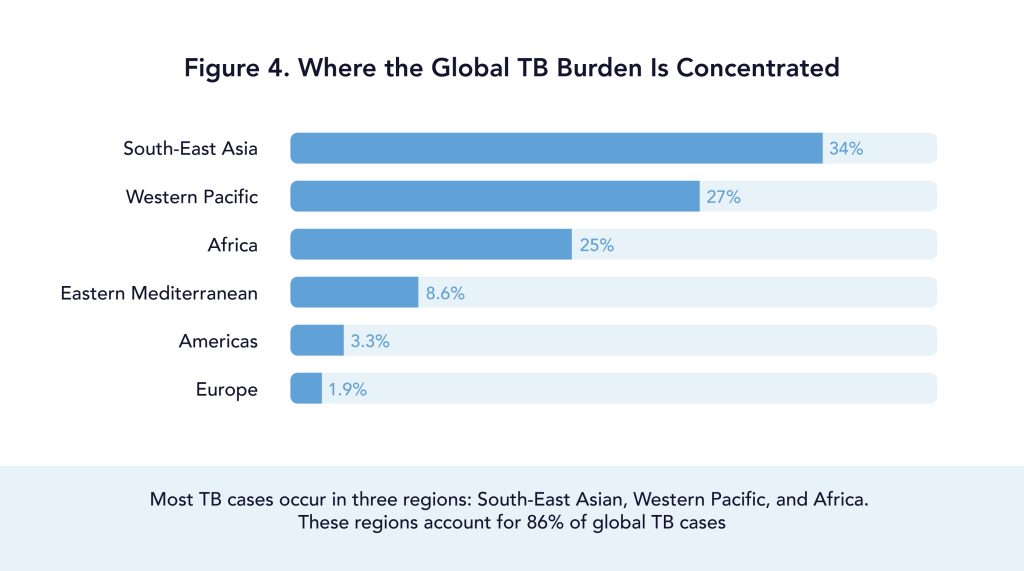
Figure 4: Regional distribution of global tuberculosis cases in 2024, highlighting the concentration of disease burden in South-East Asia, the Western Pacific, and Africa. Data derived from the WHO Global Tuberculosis Report 2025.
Global Impact and Response
Tuberculosis continues to be a major global health challenge and was already widespread before WHO declared TB a global public health emergency decades ago. In 2024, TB was the 10th leading cause of death worldwide and the primary cause of death from a single infectious agent.1 The World Health Organization set ambitious goals (the End TB Strategy) in 2015 to reduce the TB incidence rate, number of deaths caused by TB, and the percentage of people facing catastrophic costs associated with TB. Similar efforts were put forth by the United Nations in 2018 for TB treatment targets and although these efforts have not yet met the ambitious 2035 targets, substantial progress has been made toward improving TB detection, treatment, and prevention worldwide.1
Global initiatives continue to track progress toward TB control targets outlined at the 2023 UN High-Level Meeting on TB. However, the need to increase funding for TB prevention, diagnosis, and treatment remains urgent, as only $5.9B was spent in 2024 (27% of target by 2027). Twenty-four percent of the $5B target for TB research funding has been raised by 2023, and six new anti-TB vaccines were in Phase III trials as of the summer of 2025.1
Supporting Tuberculosis Drug Discovery
Continued progress in tuberculosis treatment depends heavily on the discovery and evaluation of new antimicrobial compounds capable of overcoming drug resistance and intracellular persistence.
At Microbiologics, we support researchers working to develop the next generation of anti-tuberculosis therapies. Our scientific team provides validated Mycobacterium tuberculosis anti-infective screening services, including broth microdilution susceptibility testing performed in BSL-3 laboratories designed for high-containment pathogen research.
Our customizable panels include drug-susceptible, MDR, and pre-XDR Mycobacterium tuberculosis isolates, enabling researchers to evaluate novel compounds with precision while aligning with CLSI M24 antimicrobial susceptibility testing standards. We also offer consulting services to help you plan and/or write the microbiology section of your upcoming IND or NDA.
Researchers developing new antimicrobial candidates can expand their screening programs to include Mycobacterium tuberculosis using validated testing workflows and characterized isolate panels from Microbiologics. Schedule a consultation with our scientific team to learn more.
Resources:
- Global Tuberculosis Report 2025. World Health Organization.
- Loddenkemper, R., Murray, J.F. (2021). History of Tuberculosis. In: Migliori, G.B., Raviglione, M.C. (eds) Essential Tuberculosis. Springer, Cham. https://doi.org/10.1007/978-3-030-66703-0_1
- Paulson, T. 2013. Epidemiology: A mortal foe. Nature502:S2 – 3.
- Bussi, G, and Gutierrez, MG, 2019. FEMS Microbiol Rev Vol 43, No 4.
- Provisional 2024 Tuberculosis Data, United States | Tuberculosis Data | CDC
- Gengenbacher, M and Kaufmann, SHE, 2012. Mycobacterium tuberculosis: Success through dormancy. FEMS Microbiol Rev 36: 514 – 532.
- Hansen’s Disease (Leprosy). CDC. https://www.cdc.gov/leprosy/index.html.
- Bovine TB in Humans Fact Sheet. CDC. About Bovine Tuberculosis in Humans | Tuberculosis (TB) | CDC
- Basic TB Facts | TB | CDC. About Tuberculosis | Tuberculosis (TB) | CDC.
- Cambier, CJ, Falkow, S, and Ramakrishnan, L. 2014. Host evasion and exploitation schemes of Mycobacterium tuberculosis. Cell 159: 1497 – 1509.
- Pieters, J 2008. Mycobacterium tuberculosis and the macrophage: Maintaining a balance. Cell Host and Microbe. 3: 399 – 407.
- Warner, DF. and Mizrahi, V. 2007. The survival kit of Mycobacterium tuberculosis. Nature Med.13(3): 282 – 284.
- Connolly, LE, Edelstein, PH, Ramakrishnan, L. 2007. Why is long-term therapy required to cure tuberculosis? PLOS Medicine 4(3):435 – 441.
- https://www.cdc.gov/tb/hcp/clinical-overview/drug-resistant-tuberculosis-disease.html
- Am J Respir Crit Care Med Vol 211, Iss 1, pp 15–33, Jan 2025
- WHO operational handbook on tuberculosis. Module 4: treatment and care. Geneva: World Health Organization; 2025. Licence: CC BY-NC-SA 3.0 IGO.
- Barazani, O.; Erdos, T.; Chowdhury, R.; Kaur, G.; Venketaraman, V. New Advances in the Development and Design of Mycobacterium tuberculosis Vaccines: Construction and Validation of Multi-Epitope Vaccines for Tuberculosis Prevention. Biology 2025, 14, 417. https://doi.org/10.3390/ biology1404041
- Hoseinpour, R., et al. 2024. Tuberculosis vaccine developments and efficient delivery systems: A comprehensive appraisal. Heliyon 10 (2024) e26193




0 Comments